Showing posts with label John Vorperian. Show all posts

Thursday, November 7, 2013

1970 Mets Fantazy Card Opening Day Line-up


This is when I jumped aboard the Mets Fanwagon. After all the buzz of the 69 World Series and me getting more into baseball as a result, I just had to get out to Shea and see these guys play. They were the World freakin' Champions! Alot of people felt that way. The Mets had the biggest turnout in attendance in their history(4,366,390 total, 2,697,373 at home). That record would stand until 1985.

So the Mets had won a World Series before they ever won an opening day game. Ha! That's wacky stuff.
_______________________________________________________

The Mets year started on a very sad note, unnoticed by me as a kid. I'm sure there were serious and knowledgeable Met fans who felt the loss of Johnny Murphy deeply, but I wasn't one of them.

As a kid I only knew the Mets I saw on the field and on baseball cards. I knew they had a front office that found players, made trades, etc., but I wasn't really interested in that aspect of the game at such a young age. So I don't remember hearing anything (I certainly didn't read newspapers in 6th grade) about Murphys passing.


When I did become interested in such things years later I would find out that Johnny died right after his crowning achievement, the '69 Mets. On December 30, 1969, Murphy was felled by a heart attack at his home in Yonkers, New York. He was taken to New York’s Roosevelt Hospital, where he died on January 14, 1970, following another massive heart attack. He was buried at Woodlawn Cemetery in the Bronx.
John Joseph Murphy was 61.

This was very sad and also quite a loss to Met management.

Johnny Murphy and Bing Devine were the primary architects who assembled the late 60's early 70's Met teams. One of the last things Murphy did as team V.P. was bring Gil Hodges back home to manage the New York franchise. Speaking of franchises, Devine pushed the Mets in the direction of Tom Seaver.
Now both were gone (Murphy had become Mets General Manager when Bing returned to run the Cardinals, from whence he came).

Did you know that Johnny was an all-star relief pitcher with the New York Yankees once? How about this?: Murphy started 20 games for Yanks in 1934—completing 10—and tossed another 20 in relief!
You can learn lots about John Joseph Murphy here (click link), and if you are a Mets fan, you should, because he was important.

_______________________________________________________
My first Mets Yearbook.
The Mets were defending champions. Now I'm sure every year a team takes the field and they can say that, and they can be proud. But no team could have ever been prouder than this group of guys, and they looked it. They played like it.

Or tried, anyway. This was a Met team that would be taken seriously. Not that they were a big and powerful team. As in 1969, they weren't. But when firing on all pistons they were a force to be reckoned with. Teams now felt they had to keep their eye on them out of the gate. They were resourceful and sneaky and found ways to win. They had rich, young pitching that would never again be underestimated. Only praised.

This was a new phase in Met history. They could no longer get off the hook as being lovable losers. They were a real first rate, contending major league baseball team. Things would now be expected of them. Playing good baseball, for instance.

Twelve year old me watched them this season, first time I ever followed a sports team with real interest.
They played pretty good baseball.
_______________________________________________________
_______________________________________________________
Batting first for the WORLD CHAMPION NEW YORK METS is centerfielder and World Series hero Tommie Lee Agee.


Tommie Agee was now the Mets lead off guy and in 1970 you thought he always would be. He was so good, smooth, a perfect fit for the type of team and line-up that manager Gil Hodges wanted to deploy. Agee could have been a three or four hitter on most teams. But Gil wanted him at the top because of his deceptive speed.
Tommie did everything slow and old looking, all his movements and mannerisms. I thought then that this was an intentional ploy so that when he ran he looked faster. I kid, but Agee did look slow in everything that he did while the ball was not in play. Like he was saving his energy or something.

Hodges stuck with this strategy of using his big gun at the top of the lineup, mixing and matching other spots while he waited for Johnny Murphy to get him an additional slugger. Murphy, who had been the one to secure the trade for Agee, eventually got Donn Clendenon to round out the '69 team.

Agee responded in 1970 with a career year in many departments, leading the team in hits(182). doubles(30), home runs (24). Also leading in batting avg.(.286),slugging percentage(.469) and on base plus slugging(.813). His totals in hits, runs and stolen bases (31) were new Met records. He established another Mets season record for total bases in 1970 with 298. That lasted until in 1987 when Darryl Strawberry recorded 310.

On this opening day Tommie had 3 hits in 6 at bats. He scored 2 runs and stole a base, a big contributor to the Mets first ever opening day victory.

I went to around 15 games at Shea in 1970 and watched a slew on T.V.
It's no wonder I was Tommie Agee in the playground during the summer of '70.
______________________________________________________
Batting second is the shortstop Buddy Harrelson.
Over the years Roy McMillan, Casey Stengel and Gil Hodges molded Buddy into a confident shortstop. This coupled with his great baseball instincts would serve him well throughout his long career. I didn't know until researching this post that Bud became a switch-hitter at Casey Stengels suggestion. Harrelson batted lefty one time because the Mets were facing a knuckleballer. He got a hit. Casey liked Buddy's swing from the left side and from that moment on he worked at becoming a switch hitter. Eventually Gil, an advocate of platooning, would say he liked Harrelson better from the left side.

I liked Bud in the two slot. I thought he accented Tommie Agee leading off excellently. Buddy was a switch-hitter who could do many things if Tommie reached. He not only had no problem giving himself up, he was one of the best bunters on the team. And if Agee didn't reach and Buddy did, he could steal a base. Harrelson scored 72 times in 1970, and stole 23 bases (his previous season high was 12). Most impressively he drew 97 walks in 157 games.

Today, to start the season, Buddy had one hit, a single in the 7th. He successfully bunted Agee to second in the 10th.

______________________________________________________
Joe Foy will bat third and play third.

The new Met third baseman went 0 for 4 in his debut. He did drive in one run. Tommy Agee scored the Mets 3rd run on Joe's sac fly in the 3rd inning. This gave the Mets a 3-2 lead at the time.

Foy has the distinction of being my first experience with a player who was a bust. This was a good thing, training in a sense. Because there were bigger and badder trades and busts on the near and far horizon, and as a Mets fan I learned to endure very early on. And in comparison to future ones he wasn't really that bad a bust.

The Mets released Ed Charles right after the '69 season. Ed was getting up there and he decided to retire on top.

New York then traded outfielder Amos Otis and pitcher Bob Johnson to the KC Royals to get Foy.
Johnson would become a 200k pitcher for KC in 1970. Otis became an all-star outfielder for years to come.
This was one of Johnny Murphys last moves before his death and that's a shame. But I think we would have let him slide.
When the Mets were heating up in '69 and Murphy was looking for additional parts, teams were asking for Otis and Ryan. He was able to get Clendenon without moving either of them.
He felt he needed a third baseman bad enough for the '70 season to put Otis on the block, but still held back Ryan.

At the time, looking at the back of Foys baseball card, I liked his numbers. Things popped out at me. He hit 16 home runs in 1967, drove in 71 runs in '69. He stole 37 bases one year! He's gonna be an upgrade on good ol' Ed Charles, right?

Joe's first year in the majors, with Boston in 1966, was arguably his best season. Foy batted a solid .262, drew the second-most walks in the American League (91), had a .364 on-base percentage, good for eighth in the junior circuit; he also scored 97 runs, fifth in the league. His numbers seemed to slip in 67 and 68, but he still reached base handily (in comparison to other MLB players) during these "years of the pitcher".
_________When I read the caption I thought : are you kidding me? Argentina Images should really correct this error.


Okay, it's getting a little strange now Johnny. Lil' bit.
The introduction was done in the bathroom?

Foy posted a career-best .373 OBP while hitting .236/.373/.329 with 6 home runs and 37 RBI in 322 at-bats with New York. So he was at least as good as Ed Charles would have been, stat wise.
His best day as a Met, and perhaps of his entire career, came on July 19, 1970 when he went 5-for-5 with a double, two home runs, and five runs batted in as the Mets beat the Giants, 7-6, in 10 innings at San Francisco.
His worst day might have been the day he allegedly played stoned. If I can confirm that story (linked) to be true I can redden his eyes a little more in this colorization. Lil' bit.


UPDATE: I've confirmed the story from 3 sources. My sources will remain confidential because it's kool to be able to say that. Here's Joe under the influence, as promised.


______________________________________________________
Batting clean-up for the Mets will be left fielder Cleon Jones.

Cleon was coming off his best season at the plate. He was third in the N.L. in batting with a .340 average in 1969. He stroked 25 doubles, 12 homers and drove in 75. Cleon was the starting left fielder in the '69 All-Star Game.

Jones would not come near .340 in 1970 (.277), but he would set a team record with a 23 game hitting streak.

Cleon came out of the gate with a 2 for 4 day. He drove in Agee in the first with a double, and almost drove him in again in the tenth with a single. Tommie was out at the plate to end the inning.
______________________________________________________
Art Shamsky will play first today and bat fifth.

Shamsky usually platooned out in right with Ron Swoboda and from time to time would spell Cleon in left.

After the season started and things started to jell out, Shamsky found himself in the clean-up spot 54 times. That's pretty substantial and, no offense to Mr Shamsky, another example showing how the Mets had no real number four guy. Art had a fine year batting .300 in 100 games. He pumped out 14 homers and drove in 47. Nice numbers from a platoon player but not your standard clean-up hitter in the majors.
Hodges, through careful manipulation, got the most he possibly could out of the four slot.

He got it today as Art delivered 2 hits, a RBI single scoring Jones in the first and a double in the 6th.
Mike Jorgenson would pinch hit for Shamsky in the 11th inning and start the winning rally.

_______________________________________________________
Batting sixth and playing right field for the Mets is Ron Swoboda.

This was Rons last season with New York. Well, with the Mets. He was heading north to Canada. Down the line he would show up in the Bronx and allow me to experience my first Met to Yankee "defection". But things were different in those days. Some of my best friends were Yankee fans and I didn't care. The Yankees sucked during this period, my formative Met years. Maybe that's why I continue not to care what they do today. Aside from when we play them, of course.

Swoboda had one hit on opening day 1970. He also reached on error and scored a run in the 11th inning winning rally.

_______________________________________________________
Wayne Garrett will play second base and hit seventh today.

Garrett was signed by the Braves after graduating Sarasota High School in Florida. GM Murphy grabbed the versatile young infielder for $25,000 from the Braves in the Rule V draft after the 1968 season. He was the only major league selection by New York.

Wayne was a solid fielder who could play all around the infield. He had some pop and some speed. He was mostly used in platoon situations. In a few short years he would become the Mets regular everyday third baseman.

Today Wayne went 0 for 3. He was intentionally walked and laid down a successful sacrifice in the 11th, moving 2 base runners into scoring position.
_______________________________________________________
Hitting in the 8th position is catcher Jerry Grote.
This was the year that Grote barked at me and I lost all admiration I had for him. Not respect though. I still thought he was one of the best catchers in the game.

The story: A little hazy to me. It had to be photo day or something like that. I was at the game early (I always got there early in those days, walking to Shea through Flushing Meadows Park with my buddies).
Fans were invited to come down to the field level seats, to the rails surrounding the field. All the players had come out on the field and were standing around for pics, signing autographs, chatting.

I remember having conversations with Met players in those days. This one with Grote didn't go well. Well, it really wasn't a conversation either. I was on the railing literally right up against side of the Mets dugout. Fans were all hanging over the rails and reaching out to players with programs and pens.

I saw Jerry Grote sitting dejectedly on the bench in the Mets dugout and leaned in as far as my waist would let me, reaching out with my program and pen and said: "Jerry, can I get an autograph?" Grote looked straight at me with eyes like slits of hate and yelled: "GET YOUR FUCKIN' HANDS OUT OF THE DUGOUT!"

I thought I saw smoke coming out his ears.

Little 12 year old me was no stranger to foul language. I grew up in NYC. But I was still in shock. Lil bit. I felt a big dreadful pit in my stomach that said Jerry Grote and I will never be able to be friends now. And a little part of me wanted to burst out laughing. I must have looked confused. But what really struck me was how could a ball player be so miserable? He was playing ball for a living. Well, takes all kinds, I thought. Or a bad day. Who knows. A few years later my response might have gotten me in trouble but all I said at 12 yrs old was "Jeeze, sorry", and stopped making like the elongated boy.

That stuck with me though. I never again tried to seek an autograph of a sports figure or celebrity (unless paid for at a show)or anybody. I would simply ask to shake their hands. Or just extend mine, and I never met a person who didn't shake it.

If I ever come in contact with Mr. Grote these days, I would seek neither. But if he asked, really pressed me, I'd have to say :"Yes Mr. Grote, you were one of the best defensive catchers I ever saw play, you asshole son of a bitch."

Grote was 0 for 4 on opening day. I guess that could make him grouchy.
_______________________________________________________
Tom Seaver will start his 3rd opening day for New York and bat ninth.

Tom was on top of sporting world as one of the games top performers coming into 1970. He was now on a scale that Mets fans were not used to.

On April 22, 1970, Seaver set a major league record by striking out the final 10 batters of the game in a 2-1 victory over the San Diego Padres at Shea Stadium. Al Ferrara, who had homered in the second inning for the Padres' run, was the final strikeout victim of the game. In addition to his 10 consecutive strikeouts, Seaver tied Steve Carlton's major league record with 19 strikeouts in a nine-inning game. By mid-August, Seaver's record stood at 17-6 and he seemed well on his way to a second consecutive 20-victory season. But he only won one of his last ten starts, including four on short rest, to finish 18-12. Nonetheless, Seaver led the National League in both ERA and strikeouts.

How much more great stuff can I say about Seaver? (And I have many more opening days to go, lol). He was bigger than big, taller than tall, just like Gigantor (The Space Age Robot).

Tom pitched a good game to begin the '70 season. He went 8 innings giving up 3 earned and striking out 5. Unfortunately Pirate All-Star Roberto Clemente singled in Matty Alou to tie it in the 6th and Tom didn't get the win. Rod Taylor would in relief.
_______________________________________________________
_______________________________________________________
I apologize in advance but I can't bring up Gigantor with out making a baseball card for him. Getting him to pose was a bitch.
On second thought it should be a '64 Topps card. Duh. And he's not just any robot.
________Ahh, maybe that wasn't such a good idea.
______________________________________________________
CREDITS:
> The Ultimate Met Data Base
>Some excerpts from an article at SABR by John Vorperian were used in the section regarding Johnny Murphy.
> Other quotes are linked to source.
>Steves Photography for the color photo of Bud Harrelson by the cage.
>The excellent painting of Tom Seaver's record K day was by :
>The photograph of Tom Seaver in action on his 1970 Fantazy Card was taken by the great Neil Leifer.
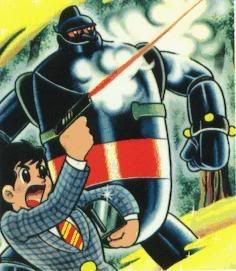
>Gigantor is an old cartoon I loved as a child. If you know the tune sing along to the Gigantor Theme:


Gigantor, Gigantor, Gi-gaaaa-aaaantor.

Gigantor the space aged robot,
He's in your command.
Gigantor the space aged robot,
His power is in your hand.

Bigger than big, taller than tall,
Quicker than quick, stronger than strong.
Ready to fight for right, against wrong.

Gigantor, Gigantor, Gi-gaaaa-aaaantor.


Wednesday, October 9, 2013

Mets Hall Of Fame Players: No.20-The Tommie Agee Story

“The first thing Gil wanted to do was acquire Tommie Agee. He wanted a guy to bat leadoff with speed and that also could hit for power.”~Bob Murphy


Cleon got a 1970 insert booklet. But not Tommie? Come on Topps! I think they picked one player for each team (there were 24 of them), and Cleon did have a hell of a year. Still, they should have made one comic for each team and two for the Mets. They were the champs! I used a lot of stuff from Cleon's 1970 Topps insert booklet (as well as other '70 booklets and comics) to create:
If you're interested in Cleon Jones actual Topps 1970 insert comic you can view some pages here at Centerfield Maz, who has been informing and entertaining Met fans for a long time now. We all appreciate it Mazman.


_________________________CREDITS:_______________________
>The Tommie Agee Story 1970 Topps Insert Booklet was based on an article from the Baseball Biography Project at the S.A.B.R. (The Society For American Baseball Research) written by John Vorperian. Excerpts were also used from the book The Amazin' Mets, 1962-1969 By William J. Ryczek.
> The Ultimate Met Database & Baseball Reference
> Topps 1970 Insert booklets: Cleon Jones, Vida Pinson, & Ernie Banks.
> "The Montgomery Story" a 1956 civil rights pamphlet about Martin Luther King.
> The Crane Pool Forum: Members photographs, information and recollections have been invaluable.
> Cartoonist Bruce Stark (Tommie Agee Poster, Gil Hodges)
> Photographer Sharon Chapman (Agee Mets Hall Of Fame Plaque)
> Markchidc of DEVIANTART for AARON batting (pg15)
> Wikipedia- Tommie Agee page
> Upper Deck (Agee portrait #2)
_______________________________________________________
This comic was made in tribute to Tommie Agee who was my favorite player when I first became a Met fan. Above you can learn about him. Here I want to say what Tommie Agee meant to me.

If Tommie didn't make those two catches in the 1969 World Series it's very possible that I don't become, not even just a Met fan, but a fan of the game of baseball. Before '69 I had gone to some games with my dad, Mets and Yankees, but I wasn't yet really into baseball.
I was more into Batman, Rat Patrol, The Man from Uncle and Star Trek. I played with Hot-Wheels and Major Matt Mason.

The '69 World Series was big news but basically a peripheral event to me. I didn't see any of the games then. I was in school or out playing. But I did see the highlights. Everyone saw the highlights. And the following season I tuned in to as many Met games as I could. Not to watch them play, but to watch the new opening montage of '69 World Series highlights set to the theme of Meet The Mets. Sometimes I'd watch the game but most times just the opening. I could never get enough of seeing that new intro. It was right about this time I started to want to play baseball.

(This is similar to the 1970 Mets WOR-TV opening
but not the same one. Some clips were re-used but this
must be from 1972 or '73 because Willie Mays is in it.)


I started playing ball with a group kids down in the red rink (pictured below), choose-em up games. At first I was always one of the last chosen. I wasn't such a good hitter to start. I really wasn't a good ballplayer at all. But I could field, or so I thought. When they asked me what position I played I feebly said "centerfield". I wanted play center like Tommie Agee. Didn't matter if I knew little about the position. Didn't matter that I really didn't know if I could catch fly balls as well as I had hoped I could. Of course, it did matter to the team captains.

They put me at catcher. It wasn't that first game, but early on there was a big play at the plate. I was catcher and the throw came in and who was barreling down the third base line but the playgrounds biggest bully, Gary Meanie. The throw arrived seconds before he did and I just knew he was going to try and run me down.


 A few months later I would see Pete Rose barrel down Ray Fosse in the All-Star game, but that hadn't happened yet, so I didn't know it would be better to run for the hills as opposed to standing my ground.

This is a recreation of the red rink circa 1970
So I looked up and here's Meanie, easily twice my size, charging right at me. I knew he wouldn't slide. We played on cement. So I stood my ground, braced myself and put my throwing hand into my glove and clenched the ball.

>>>>>>>>>BAM!!!__________________________The Red Rink.^


I remember seeing Gary Meanie grimacing in my direction and then.....the sky. And a group of heads looking down at me. One was holding up some fingers and asking me to count how many he had up. I didn't care. I held up my own hand and the ball was still in it. "He's OUT!" I yelled as I sat up and felt a huge bump on the back of my head where it smacked the pavement.

The guys were laughing but they also had a new found respect for me. I didn't realize this til next game when we chose up new sides. I figured I'm a catcher for life now, so I didn't expect to be asked , but I was. I was also now picked in the middle of the pack. "I got Warren! What position do you want to play?" This time I confidently said "center!". "Okay, you got center."

I ran out to the outfield and I didn't just act like Tommie Agee, I was Tommie Agee for the rest of the summer of 1970. It didn't matter that he was a black man. It didn't even occur to me. I only knew I wanted to play baseball like him.

I made some good catches too. And when I wasn't chasing one down I'd park under a fly ball and tap my glove a few times, just like Tommie did before a catch. And with that bit of confidence and from watching more and more baseball, I began to hit.
 At bat as well as in the field, I was Agee.

I'd lazily swing my bat and tap the plate with it while awaiting the pitch. I wouldn't be switching to an open stance until 1972, when I saw Willie Mays do that. But now, this hot summer, I was Tommie.

Childhood idols can be fleeting things and the following summer of 1971 I became Brooks Robinson and wanted to play third base. But I will never forget the player who spurred my imagination and inspired me to want to play baseball.

Even with Agee's declining performance in 1971 & '72 I enjoyed watching him play. He had a decent year in '71. When the Mets got Willie Mays in '72 that made for an awkward moment for me. My two favorite centerfielders were now on the same team. But, fortunately or unfortunately, that only lasted a moment in baseball time, or so it seems now. New York got Willie in May of '72 and after the season had ended, traded Agee to the Houston Astros. I was bummed, but I didn't complain. I could now go out to Shea and watch Willie Mays play baseball. That softened the blow. A lil' bit.

After that I didn't follow Tommie's career other than what was on his baseball card. I once saw him on T.V. make a nice diving catch for the Cards on a Monday game of the week. It was a lot like his second catch in game 3.

When Agee retired after being released by the L.A. Dodgers in spring training in 1974 I don't even think I was aware of it right away. Over the years I saw Tommie return to the Mets for events and such. I wish I met the man.

From what I've read about him growing up in Mobile he already had the odds stacked against him because of the color of his skin. I'd have him know that it was because of him I saw beyond the color of a mans skin and learned to judge a man by his deeds. And for that one summer in 1970, I was very proud to make believe I was Tommie Lee Agee.


_________________________________________________

Tommie Agee's Fantazy Met Cards will be added here as they are released.


I don't like to mess with reality and create any alternate universes with my fantasy cards but I'll make an exception for Tommie and have him win game 7 of the 73 World Series.